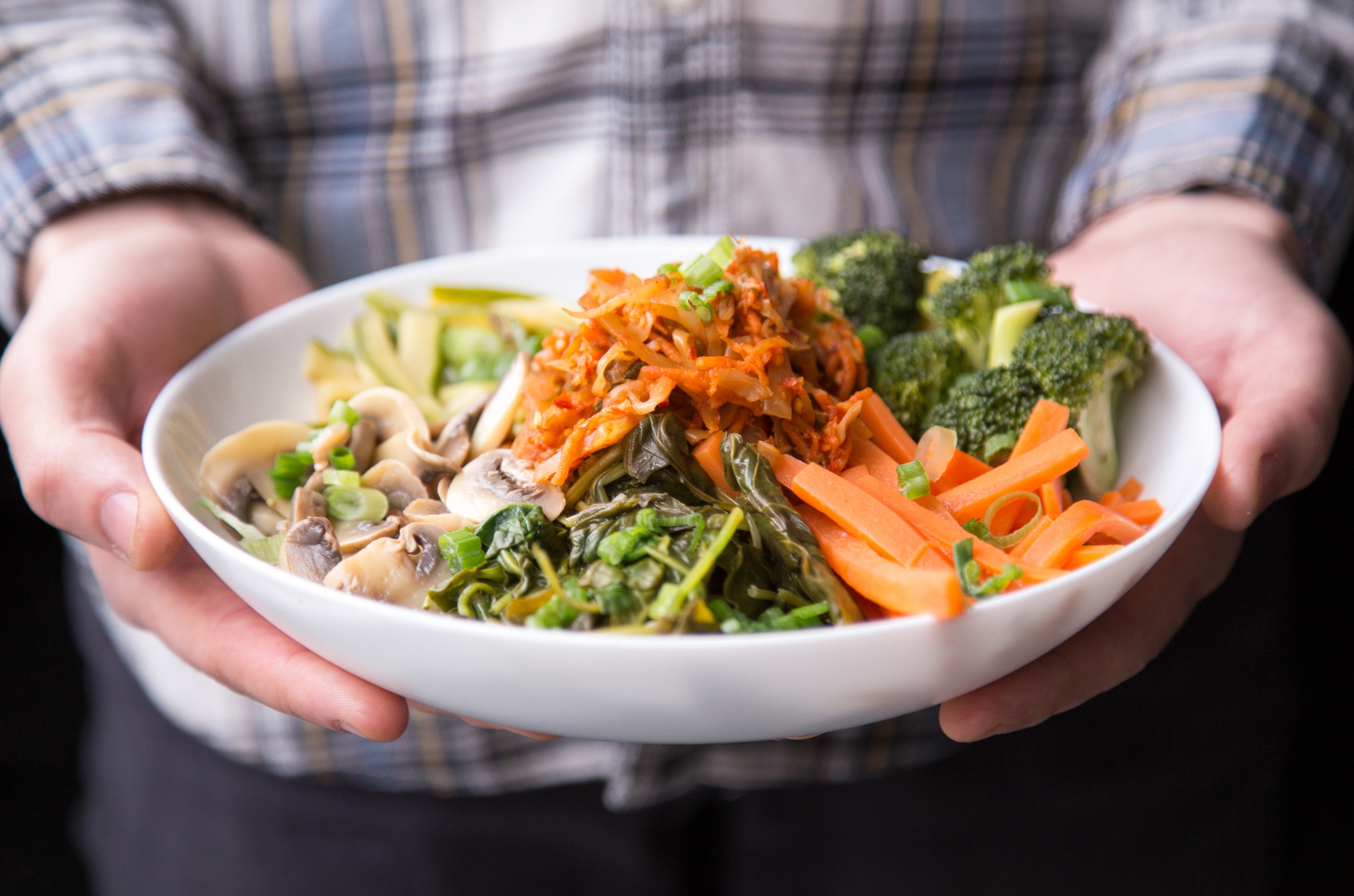
Eat in the Heat (Vegan-Style)

It’s been hot as h-e-double-hockey-sticks in my hometown of Baltimore, and when it is this disgustingly oppressive, I have a hard time wanting to eat food.

Recently, I went to North Carolina to visit a friend. While I was there, two of my mom’s cousins met up with me to take me to brunch. Raleigh was not faring much better than Baltimore with the heat—at the time that they picked me up (about 11:00 in the morning), my phone was reporting a temperature of 97 °F. We went to what was apparently a super popular breakfast/lunch place and were told that the wait would be at least an hour, or we could be seated immediately outside. We saw that the line for indoor seating was so long that it was out the door, so either way we knew we’d be hot. We opted to sit outside because at least then we’d be served quicker. But as we sat down under that hot, unforgiving sun, and my sweat trickled down my back, and my penciled-on eyebrows melted like butter, and my hair effortlessly resisted the “anti-humidity” spray I had spent too much on, and then a plate of warm biscuits was placed on our table…I already knew I’d be asking for a take-home box.

So, since we are only halfway through the summer, I decided to round up some ~chilled~ (or room temperature) vegan recipes to beat the heat that make me want to eat! Take a look below (click links for recipes) and let me know if you have more suggestions!

Tangy Veggie Wrap

This wrap is not only delicious and easy to make (“No cooking skills are needed for this one…It’s literally just throwing the right ingredients together!”) but it’s also healthy AF. One wrap contains 16 grams of protein!

*vegetarian, but you can use vegan cottage cheese and vegan yogurt/sour cream

Balsamic Tofu, Quinoa & Strawberry Summer Salad

YUM. I’m a huge fan of fresh strawberries and this salad is a great way to incorporate it with enough other nutritional ingredients to make it into a full meal.

Cold Noodle Bowl with Sriracha Peanut Crumble


This is super refreshing for those hot summer days, and it takes only about 20 minutes. Plus, it’s packed with a fun mixture of flavors (“crunchy, salty, spicy peanuts on top of fresh crunchy veggies, with sweet and sour hoisin and lime noodles. ALL THE YUM!!!”Avocado Gazpacho Soup

Avocado Gazpacho Soup


If you’re like me (and I feel like the good majority of my friends), you’re obsessed with avocado, and this is a cool way to taste that fresh flavor in a different way. While this recipe is geared towards those eating raw, they suggest adding a dash of hot sauce or using vegetable broth instead of water for additional flavor if you are not eating raw.

Summer Veggie Pasta Salad

Pasta salads are the epitome of summer dishes in my opinion. I love bringing them to picnics or to the pool. They’re also a great way to use up the summer vegetables you’ve been growing! The master behind this recipe also suggests adding some chopped avocado right before serving—you know I will!!

*vegetarian, but you can just skip the grated parmesan or swap with vegan cheese

Vegan Stereotypes

I don’t know if you’ve noticed, but vegans don’t have a very positive reputation. They are, unfortunately, still a heavily stereotyped group. Increasingly, it seems like unless someone already has a friend who is vegan, if they are introduced to someone who is, they immediately put them into a box before getting to know them.

Here are some of the most common vegan* stereotypes and my thoughts on them:

  • Vegans are hippies. There are so many different types of vegans/vegetarians out there. As One Green Planet puts it, “There are vegans of all walks of life, with varied incomes, styles of dress, professions, and views. There are vegan ultra-athletes, politicians, actors and actresses, doctors, lawyers, writers, singers, and artists. Some are deeply involved with environmental causes, while others are not.” It’s irrational to lump us all together. I might not have anything in common with another vegan other than what we eat/don’t eat.
  • Vegans are self-righteous. Just because we have an opinion on something that is different from yours does not mean that we are holier-than-thou. I believe it’s immoral to eat meat, and you believe it’s moral to eat meat. Why am I the one looked at as being self-righteous and not you?
  • Vegans are judgmental. This is a very common one, and I think it’s the reason that a lot of people are put off when they find out someone is a vegan – they assume we are snobby and will judge them for eating meat. “Of course, it’s natural for carnists to ask why someone is vegan, but it’s hard to explain why you’re vegan without the other person feeling like you’re insulting them personally.”
  • Vegans are just following a trend. Even if this were true, what’s the harm in it? Of all the dumb trends in the world, who cares if someone tries veganism because it’s “popular” at the time? It’s not like anything negative will come out of it. I’d say that eating veggies is a much better trend than eating tide pods, am I right?
  • Vegans are health nuts—OR vegans are unhealthy/weak. Ironically, I’ve heard both of these perceptions. Either we’re obsessed with counting calories and working out, or we’re bony and frail and don’t get enough nutrients. As Daria Zeoli says, “You can be a healthy vegan or a junk food vegan, or somewhere in the middle. It takes all kinds.” But let’s keep in mind that either way, it’s none of your business.
  • Vegans only eat salads. Here’s a fun fact—I barely like salads. And when I tell people that, they are SHOCKED. How can a vegan not like salad? Or, I’ve also heard, “How can a vegan not like [such and such] vegetable?” Ummm…I still have taste buds, and I still have preferences. I find it hard to believe that anyone out there is a fan of every single vegetable.

Now, this is not to say that all vegans stray from these stereotypes. Trust me, I know a few who tick off almost every single one of those boxes. But it’s unfair to assume anything about someone based solely off of what they decide to eat. That’s just so silly to me. Meat-eaters don’t have a stereotype associated with them, so why should vegans or vegetarians have them?

Regardless, let’s work to try and dispel these clichés and prove that our diets do not define us. After all, at least for me personally, there are a lot of other things I can be judged on—so don’t make it my food.

*These usually apply to do vegetarians too, unfortunately.

Tips & Tricks for Going Meat-Free

Personally, I have chosen to live a vegetarian lifestyle for about the last 13 years. While I will always encourage others to do the same and respect those who abstain from meat and/or dairy, I understand that changing a diet so drastically may be a large and intimidating step for some people to take. So, I’ve compiled a list of tips and things to remember that may help those who would like to transition to vegetarianism or veganism but are feeling unsure that they can do it successfully.

  1. Take it slow. Changing your diet does not have to be a drastic and immediate change. A gradual move towards vegetarianism or veganism will help ease you into this adjustment. Additionally, a slower shift is more sustainable, and likely to make it in to a long-term lifestyle move. Try beginning with just a once-a-week vegetarian meal, like a Meatless Monday challenge. Don’t be ashamed to take baby steps!
  2. Do some research. Read up on how to get all the necessary protein and nutrients from non-meat foods. Need a place to start? Check out my blog’s page on meat alternatives – it even gives you the approximately amount of protein in each one. Also look for some recipes that will introduce you to new plant-based food ideas. (You may want to start with some simple recipes so that you’re more inclined to actually make them.)
  3. Stock up. Once you know what vegetarian-friendly or vegan-friendly foods you’ll be wanting, go to the grocery store and make sure you get plenty of options. It’s easier to stick to a plant-based diet if you have the food available at home. It might also be a good idea to read up on the different food labels and what they mean so you can pick the best items at the store. (Check out my page “Learn the Language” for some quick information.)
  4. Host vegetarian/vegan dinners with your friends. Sometimes, it can help to have the support of your friends when you’re taking on a new challenge like this. This isn’t to say that the purpose of this get-together would be to change their minds and pressure them to cut out meat too. But having your buddies around all enjoying the same thing may help you start to feel more comfortable about choosing this lifestyle. (According to Self.com, “Studies show that failure to stick with a vegan or vegetarian lifestyle is often attributed to feeling ‘different’ or isolated. Food is all about community and sharing, so do your best to share this lifestyle with people you care about—even if they’re not making the change along with you.”) Also, if you can create something really yummy that’s also vegan, you’ll impress them and they’ll probably support your decision even more and may even treat you to a plant-based dinner sometime.
  5. Remind yourself of why you’re doing this. Whether it’s for environmental reasons, health reasons, or animal/ethical reasons, it’s helpful to keep telling yourself why you are making this sacrifice/change. It’s a different experience for everyone, but if it gets particularly difficult for you, just tell yourself all of the benefits of making this switch so you can reinforce your decision and encourage yourself to keep it up.

Supportive Stars

If you read my previous blog post, you know that I have had anxieties about being vocal about my vegetarianism. After thinking about it for a while, I realized that many celebrities have decided to follow a vegetarian or vegan lifestyle and are vocal about it. And they must believe it in strongly if they’re willing to discuss/encourage it, especially since their audience is obviously a lot larger than mine would be. So, I decided to do some research and find out which celebrities currently abstain from meat (or meat and dairy), and here are some of the ones that stood out to me:

Ellen DeGeneres & Portia de Rossi

Both Ellen and her wife Portia are strict vegans and have been since 2008. She had attempted going vegan much earlier, but it didn’t stick. “I’ve always called myself an animal lover, and yet I ate them,” she said. But then when someone said to her, “If you knew what chicken looked like or you knew how chicken was made, you’d never eat it again.” That did it for her, and she never looked back. In fact, Ellen and Portia are opening up a new vegan restaurant in LA!

Ellen Page

Another awesome Ellen has used her celebrity status on her social media accounts to speak out against factory farming. One such tweet: “Why are vegans made fun of while the inhumane factory farming process regards animals and the natural world merely as commodities to be exploited for profit?”

Kate Winslet

Kate is a vegetarian and her husband recently turned vegan. She says that using plant-based cooking is a form of self-care for them. She is also set to narrate a vegan film entitled “Eating Our Way to Extinction,” which will present veganism as a solution to issues such as “environmental destruction, the western diet health epidemic, and the twisted economics within the meat and dairy industries.”

Woody Harrelson

The owner of the world’s first organic vegan beer garden, Woody has been vegan for a long time and credits his diet to his good health. In the beginning, he turned vegan in order to keep his energy up; now, it seems like he is also supporting veganism for ethical reasons. He appeared in a video with another celebrity vegan, Sir Paul McCartney, encouraging viewers to reduce their meat intake due to the ethical and environmental complications surrounding animal agriculture.

Miley Cyrus & Liam Hemsworth

The power couple recently celebrated their wedding and made it a fully vegan ceremony. Miley even used the hashtag #HotNonViolentAnimalLovingHusbandsAreHottest. Miley also has the Vegan Society’s sunflower logo tattooed on her, and she is constantly making posts on social media that make veganism look…well, cool. For instance: “There is nothing more beautiful than eating a meat-free, gluten-free, dairy-free cheeseburger in the sunset.” Miley’s husband, Liam, was actually inspired by Hunger Games co-star Woody Harrelson (above) to go vegan.

Evanna Lynch

Evanna became “fully vegan” in 2015 after years of being a vegetarian. She has said, “To hurt animals is to disconnect me from that most caring, compassionate voice.” She believes that humans should not use our power to suppress or put an end to animals, but instead we should be their caretakers. It seems like the same philosophy her character Luna Lovegood would probably have!

Natalie Portman

Natalie had been a vegetarian since she was nine years old and then made the switch to vegan in 2009. Talk about dedication! Last year, she premiered her “Eating Animals” film, which brings light to the animal abuse and environmental trauma that occurs due to factory farming industries. Her helpful hint? Trick your taste buds into not knowing the different between real and faux meat and dairy.

All of these celebrities, and the countless others that support vegetarianism and veganism, have inspired me to not be afraid to be open with others about my lifestyle choice. I’m doing this for the animals, I’m doing this for the environment, I’m doing this for myself. And I’m not alone.

Owning My Decision

Sometimes I feel really awkward when I have to tell a new person (like a friend or a date) that I don’t eat meat. I never want them to feel like I’m going to try to push my “agenda” on them, or that they can’t ever eat meat around me, or that I’m a picky person. And this isn’t just in my head—this is a worry because it really has happened to me before. I feel awkward because I don’t want them to feel awkward. But at the same time, I do want to share why I think everyone should abstain from meat. I choose to be a vegetarian because of moral reasons, because I can’t justify the needless suffering and killing of animals. So if I believe so strongly in this for myself, why shouldn’t I stand up for animals in front of other people?

I became vegetarian on my own accord when, in an environmental science class in high school, I had to watch a disturbing video on factory farming. But I was the only student who was affected by it enough that I decided to change my eating habits. Even the teacher was (no joke!) eating a hamburger as he showed us the video. (He was a disgusting human on many, many levels, but let’s not go into that now…) So yeah, maybe my decision wasn’t made because someone else convinced me. But that doesn’t mean that other people wouldn’t at least consider a humane eating lifestyle if I had an open conversation with them about it. After all, doesn’t that work in other scenarios? I’m not a big news-watcher, but if someone informs me that an actor was just charged with abusing a woman, I’m going to boycott his films. If someone tells me that one of the makeup brands I use tests on animals, I’m going to promptly stop being their customer and go research cruelty-free companies. So, maybe, if I can educate my friends or family on the dark realities of factory farming, they’ll take a minute to question whether or not they can continue to consume meat with good conscience. In doing so, I may risk turning people off. I may risk annoying people who probably are just fine ignoring the pain of animals so that they don’t have to feel bad or change their ways. I may risk making them feel uncomfortable. But is their temporary discomfort a fair price to pay for standing up for animal rights? I’m going to say yes.